
Let me start with a question.
Have you ever looked around at the people you work with, or live with, and wondered…
how are they still going?
You have the same workload.
Same pressure.
Same deadlines.
And yet, somehow, they’re holding it together, while you feel like you’re quietly unravelling.
Why is that?
The Story We Tell Ourselves About Burnout
We tend to explain and rationalise burnout in very practical terms.
“I worked too much.”
“I didn’t set boundaries.” (What even are these?!)
“I pushed too hard for too long.”
So naturally, the solution becomes equally practical.
Work less.
Slow down.
Say no more often.
Take a break.
And to be fair, that does help. Of course it does.
If you take your foot off the accelerator, the engine cools down.
But here’s the uncomfortable question.
What if burnout isn’t just about how hard you’ve been pushing…
but why you’ve been pushing like that in the first place?
Why You… and Not Them?
Why is it that two people can sit in the same meeting, hear the same criticism, and have completely different reactions?
One shrugs it off.
The other feels a knot in their stomach that lasts all day.
Why does one person switch off at the end of the day…
While another lies awake at 2am replaying everything they said? Heart racing…
This is where we need to look a little deeper.

Trauma Isn’t What You Think It Is
When people hear the word “trauma”, they often think of extreme events.
War.
Abuse.
Catastrophic accidents.
And yes, those are trauma.
But trauma can also be far more subtle.
Growing up in an unpredictable household.
An emotionally unavailable parent.
Being constantly criticised.
A serious illness.
Bullying, at school or in the workplace.
A sudden loss.
Even just never quite feeling safe to be yourself.
None of these might seem dramatic on the surface.
But your nervous system doesn’t measure trauma by how it looks on paper.
It measures it by how safe, or unsafe, you felt at the time.
And when something overwhelms your system, especially repeatedly, it leaves a mark, and a pattern develops.
The Invisible Patterns You Didn’t Choose
Over time, you adapt.
You learn how to cope.
You become more alert.
More driven.
More careful.
More accommodating.
Or perhaps more shut down.
You might notice this showing up as:
- Feeling oddly disconnected, like you’re watching your life rather than living it
- Being constantly anxious and on edge, scanning for what might go wrong
- Reacting more strongly than you’d like, or sometimes not reacting at all
- Finding it hard to switch off, even when nothing is happening
These aren’t personality flaws.
They’re intelligent adaptations.
They helped you get through something.
The problem is… they don’t always switch off when the situation changes.
So What Has This Got to Do With Burnout?
Imagine driving a car for years without enough oil.
You can keep going for a while.
You might even go quite far.
But underneath, there’s friction. Heat. Wear and tear.
Eventually, one of two things happens.
The engine blows, dramatically.
Or it slowly grinds to a halt.
Burnout often looks like the same thing.
Years of pushing.
Overriding tiredness.
Staying “on”.
Meeting expectations.
Holding it together.
Until one day… you can’t.
Not because you’re weak.
But because your system has been running in survival mode for far too long, running on empty. There hasn’t been enough fuel to refill the tank.

When the Body Starts to Speak
If you drive a car without enough oil, it doesn’t always explode straight away. Parts start to fail first.
The alternator goes.
The engine overheats.
Components wear down faster than they should.
It’s the same with us.
Long before full burnout, and often even after it, the body starts to signal that something isn’t right.
It can show up as physical symptoms like:
- Ongoing digestive issues, IBS, stomach pain
- Chronic inflammation, chronic pain
- Persistent fatigue that rest doesn’t fix
- Headaches or migraines
- Muscle tension and unexplained aches
- Poor sleep or waking unrefreshed
- Hormonal imbalances
- Lowered immunity, getting ill more often
And what do we do?
We go to the doctor. We try to treat each symptom on its own.
Which makes sense, right?.
But rarely does someone ask the more fundamental question.
Have you checked the oil? And the quality of that oil?
If your system is under constant stress, if it never gets the conditions it needs to regulate and recover, if it’s expected to perform like everything is fine… eventually, something gives.
Not because the system is faulty.
But because it’s been asked to run without what it needs to function.
The Problem With Just “Fixing” Burnout
This is where it gets tricky.
You can absolutely remove the triggers.
Leave the job.
End the relationship.
Move country.
Get the newest self help book
Start yoga.
Buy a journal (we’ve all been there).
And again, these things can help you get to the next gas station, or layby.
But if the underlying pattern doesn’t change, something interesting tends to happen.
You recover…just enough..
you rebuild… just enough..
and then, slowly, you find yourself back in a similar place again.
Different job. But the same feeling.
Different relationship. But the same tension.
It can feel like life is a series of near-misses with burnout.
Always managing it, sometimes firefighting it.
Always staying just ahead of it.
That’s what we might call living in survival mode.
Constantly patching things up, rather than changing what’s driving it.

What If You Went to the Root Instead?
If burnout is, at least in part, the result of unresolved trauma, then the real opportunity isn’t just to recover.
It’s to reset the system that got you there. With the aim to thrive, not simply survive.
To create a way of being where:
- Rest doesn’t feel unsafe, it feels safe and restorative
- Boundaries don’t feel threatening, they are known, held, respected and defined
- You’re not constantly bracing for something to go wrong. The hypervigilance and bracing has lessened
- You don’t have to push yourself to the edge just to function
That’s a very different kind of life.
So… How Do You Treat Trauma?
There isn’t a single answer.
And if someone tells you there is, I’d be slightly cautious.
At Khiron Clinics, we’ve spent years exploring what actually works, guided by leading experts in the field and, more importantly, by the results we see in our clients.
One of the key things we’ve learned is this:
You can’t think your way out of trauma alone.
Talking helps, of course. Understanding matters.
But trauma isn’t just a story in your mind.
It’s something your body has learned.
What Does It Actually Mean That Trauma Is “Stored in the Body”?
When people say this, it can sound a bit abstract. Almost like there’s a file cabinet somewhere in your shoulder holding memories.
That’s not what’s happening.
What’s actually being “stored” is a pattern.
A pattern of tension.
A pattern of breathing.
A pattern of alertness.
A pattern of response.
Imagine you’re in a situation that feels threatening. Your body reacts instantly.
Your heart rate increases.
Your muscles tense.
Your breathing becomes shallow.
Your attention narrows.
This is your nervous system doing its job.
In a healthy system, once the situation passes, everything settles. You come back to baseline.
But when something is overwhelming, or happens repeatedly, that reset doesn’t fully happen.
The body remembers the state, not just the story.
So instead of returning to calm, part of your system stays slightly braced.
Still scanning.
Still ready.
Still holding tension.
Not because there’s danger now, but because at some point, there was.
It’s not the event that’s stuck.
It’s the response that never got to complete.
And over time, that unfinished response becomes your baseline.
So you might find yourself reacting strongly to something small, feeling on edge for no clear reason, or unable to relax even when everything is fine.
Not because you’re overreacting.
But because your body is still trying to protect you from something that’s no longer happening.
So if we are going to treat trauma, we need to look at it from both angles, how it affects the mind, and how it affects the body.
Top Down vs Bottom Up
In simple terms, there are two directions we can work in.
Top down
This is what most people think of as therapy.
Talking. Reflecting. Making sense of your experiences.
Bottom up
This is working with the body.
Learning how to regulate your nervous system.
Helping your system feel safe again, not just understand safety.
It might include:
- Breathing and grounding work
- Movement-based therapies
- Somatic (body-based) approaches
- Learning how to notice and shift your internal state
It sounds simple, but it’s often the missing piece.
Because if your body still feels under threat, no amount of insight will fully settle it.
What Treatment Actually Looks Like
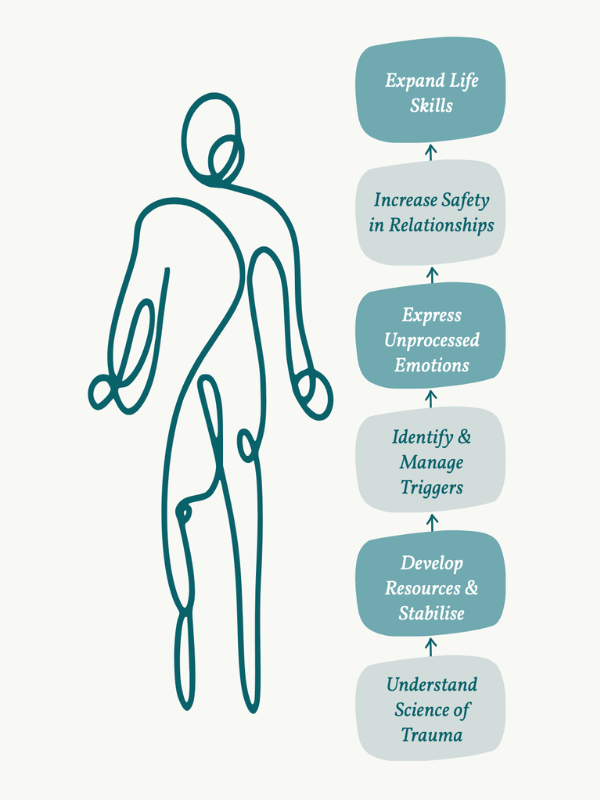
At Khiron, we tend to think of trauma healing as a journey with three broad phases.
Not rigid steps, but a helpful way of understanding the process.
- Understanding (Psychoeducation)
Learning how your nervous system works.
Why you react the way you do.
What your triggers are.
For many people, this alone is a huge relief.
Things start to make sense.
- Regulation and Processing
This is where the real shift begins.
Learning how to stay present without becoming overwhelmed.
Gently working through what’s been held in the body.
Releasing patterns that are no longer needed.
Not by forcing anything, but by creating enough safety for change to happen.
- Integration
Taking what you’ve learned back into real life. Trialling it out.
Relationships. Work. Everyday stress.
Not perfectly. Not all at once.
But with a growing sense that you can handle what comes your way, without tipping into overwhelm or shutdown.
A Different Way Forward
If you recognise yourself in any of this, it doesn’t mean something is wrong with you.
It means your nervous system adapted.
Quite brilliantly, in fact.
But what helped you survive before…
may now be what’s exhausting you now.
The good news is that these patterns aren’t fixed.
They can change.
If You Want to Explore This Further
If you’re curious about how trauma treatment works in practice, you can download our brochure to learn more about the approach we take at Khiron Clinics.
If any of this is hitting home and you want to understand more about trauma and how it shapes the way you respond to life, I’ve written a book called The Invisible Lion. It’s a simple, accessible way of making sense of all of this without the jargon.
And if reading isn’t your thing, there’s also a short video series that walks through the main concepts in a way that’s easy to follow. You can explore that here.
And if you’d rather just talk it through with a real person, you can call us.
No pressure. No commitment.
Sometimes it helps just to start the conversation.