EMDR Therapy in London

EMDR Therapy for Trauma, PTSD and Complex Trauma Available Through Outpatient Therapy, Online Treatment and Residential Care

Some memories will not settle. They surface uninvited, carry the same charge they did years ago, and pull the body back into the moment they happened. EMDR therapy can change that. It is a structured, evidence-based therapy that helps the brain reprocess distressing memories so they finally lose their grip.

Access EMDR therapy through Khiron Clinics’ specialist trauma treatment pathway, whether through outpatient therapy in London, online treatment, intensive day programmes, or residential care when a higher level of support is needed.

"I can confidently and safely say, it’s nothing short of life changing. For those suffering from unresolved trauma, and who live in this very difficult state I highly recommend Khiron." - Charlotte. M

What is EMDR Therapy?

EMDR stands for Eye Movement Desensitisation and Reprocessing. It is a structured, evidence-based psychotherapy that helps the brain reprocess distressing or traumatic memories so they no longer carry the same emotional and physical charge. EMDR was developed by the American psychologist Dr Francine Shapiro in 1987. Today it is one of the most widely used and well-researched therapies in trauma treatment, recommended by NICE in the UK and by the World Health Organization for the treatment of PTSD. 

Bio Picture of Dr Bessel Van Der Kolk

“...(my client) told me how supportive our therapy relationship had been, but that EMDR had done more for them in a few sessions than therapy with me had done in four years.”
Dr Bessel Van Der Kolk


Bilateral stimulation, tapping with emdr therapy in london at khiron clinics

How Does EMDR Therapy Work?

When something overwhelming happens, the brain can fail to process the experience fully. The memory is left in a raw, unintegrated form, still holding the original images, beliefs, emotions, and body sensations. EMDR works by harnessing the brain’s natural capacity to heal and rewire itself, a process known as neuroplasticity. It helps the brain process traumatic memories that have become stuck, reducing their emotional impact over time.

In the reprocessing phase, you briefly hold a distressing memory in mind while following a form of bilateral stimulation, most often side-to-side eye movements, sometimes tapping or alternating sounds. Holding the memory while tracking the stimulation helps the brain file it as something that happened in the past, rather than something still happening now.

As the memory is reprocessed, its emotional intensity drops. The belief attached to it, often “I am not safe” or “it was my fault”, gives way to something truer. You do not forget what happened. It simply stops dominating the present.

The 8 Phases of EMDR Therapy

EMDR follows a structured eight-phase protocol. The reprocessing it is famous for is only one phase, and the phases before it matter just as much.

  1. History and treatment planning: Your therapist takes a full history and identifies the memories to work with.
  2. Preparation: You learn grounding and stabilisation skills and build the internal resources to do the work safely. This is where a trauma-specialist clinic makes the most difference.
  3. Assessment: You and your therapist identify a target memory, the negative belief attached to it, and the positive belief you would prefer.
  4. Desensitisation: The reprocessing phase, using bilateral stimulation, where the memory’s charge reduces.
  5. Installation: Strengthening the positive belief until it becomes the new, felt truth.
  6. Body scan: Checking for any physical tension still linked to the memory.
  7. Closure: Making sure you leave each session settled and stable.
  8. Reevaluation: Reviewing progress at the start of later sessions and deciding what comes next.

Phases one and two focus on creating safety, stability, and emotional resources. This groundwork plays a vital role in the success of EMDR therapy, which is why we never rush the preparation process at Khiron Clinics.

What EMDR Therapy Treats

EMDR is designed to help people process traumatic or distressing experiences that continue to affect them in the present. Whether it is right for you depends on your personal history, current symptoms, and how those experiences are still impacting your nervous system, which is why we assess every client individually.

EMDR for PTSD and Trauma

EMDR was built for, and is best evidenced for, PTSD and single-event trauma: assault, accidents, medical trauma, bereavement, and similar experiences where one memory holds the charge. Reprocessing that memory reduces the intrusive symptoms that keep the event alive in the present.

EMDR for Complex Trauma and CPTSD

For complex trauma and CPTSD, EMDR is used carefully, inside a wider programme. Complex trauma usually involves many interlinked memories and a nervous system organised around protection for a long time, so stabilisation and pacing matter even more than they do with single-event trauma.

EMDR for Anxiety, Panic, and Phobias

When anxiety, panic, or a phobia traces back to a specific traumatic experience, EMDR reprocesses the memory at the root rather than only managing the symptom. Treat the source, and the responses built up around it begin to ease.

EMDR for OCD, Depression, and Other Presentations

EMDR also helps with the trauma-linked dimension of OCD, depression, grief, and other presentations where unprocessed memory plays a role. The aim is not to label a diagnosis, but to reach the experiences the nervous system never had the chance to resolve.

What Happens in an EMDR Therapy Session at Khiron Clinics

In the early sessions, the work is not reprocessing. Your therapist takes a careful history, listens to your story, and helps you build the grounding and stabilisation skills trauma work requires. This is the foundation everything else rests on.

In a reprocessing session, you and your therapist identify a target memory, the negative belief linked to it, and the positive belief you would prefer. You hold the memory in mind while following bilateral stimulation, usually eye movements, in short sets, with your therapist checking in between each one. There is no need to describe the memory in detail. You simply notice what comes up and report it briefly.

Session length depends on your treatment plan. Every session ends with closure, so you leave settled rather than carrying activation out of the room. This is standard EMDR practice, and it is central to how Khiron Clinics paces the work.

EMDR Therapy in London and Online

Trauma can arise from various experiences, whether a single event or prolonged exposure to stress.

Two women sit facing each other, discussing what is trauma in a bright room with plants, a white fireplace, and neutral decor. One gestures as she speaks whilst the other listens attentively.

In-Person EMDR Therapy near Harley Street, London

Our trauma-focused outpatient clinic sits near Harley Street in central London, and EMDR is one of the therapies available in our programme. You are seen by clinicians who work within Khiron Clinics' wider trauma-informed model, not in a standalone EMDR room.

Online EMDR Therapy​

Online EMDR therapy is delivered through secure video sessions, using on-screen bilateral stimulation or guided tapping. It is well-established and available if you cannot attend in person. For some clients with complex trauma, in-person work is recommended, and we decide that together at your initial consultation.

A cosy bedroom features a beige tufted headboard, white bedding with a green throw and pillow, a white bedside table with a modern black and gold lamp, and dark green curtains—creating a soothing retreat for anyone wondering what is trauma recovery.

Residential EMDR Therapy

Residential EMDR therapy is delivered within our specialist trauma treatment programme. Alongside EMDR, you are supported by a trauma-informed clinical team, structured daily support, and complementary therapies. This can provide the stability needed for deeper therapeutic work.


Book an Initial Consultation

Begin EMDR Therapy at Khiron Clinics

A woman getting mental health treatment for trauma at Khiron's Residential Mental Health Clinic

Every client who begins EMDR therapy at Khiron Clinics first has an initial consultation where you meet a senior member of our clinical team, share your story, learn more about our trauma-focused approach, and gain insight into the root causes of your symptoms.

Initial consultations take place at our clinic near Harley Street in London, online, or at our residential clinic in Oxfordshire depending on what suits you.

Afterwards, you receive a written summary, a clinical formulation, and a treatment recommendation, so you can review everything at your own pace before deciding on next steps.

Two women engage in a heartfelt discussion in a bright, modern room. The woman with long hair and a blazer sits on the sofa, sharing insights on how we treat trauma, while the other listens intently. A large potted plant and window add to the serene atmosphere.

Frequently Asked Questions

Whether you recieve treatment at our outpatient clinic  London, online, or at our residential clinic in Oxfordshire, the cost depends on how EMDR fits into your wider treatment plan, which is established after your initial consultation. Because EMDR at Khiron Clinics is delivered within a trauma-informed pathway rather than as a single isolated session, pricing is discussed directly so it reflects the care you actually need. Our brochure provides a guideline for our fees, and our team can also talk them through with you.

EMDR is sometimes used alongside other treatment for people with psychosis or schizophrenia, but only with careful assessment and close clinical support. It is not suitable for everyone, and the timing and pacing matter a great deal. Whether EMDR is appropriate is decided with a specialist who understands both trauma and your full clinical picture.

For a single, recent trauma, some people need only a handful of reprocessing sessions. For complex trauma built from many experiences over years, the work takes longer, because stabilisation and pacing come first. The number is shaped by your history and your nervous system, not by a fixed package, and we review it with you as treatment progresses.

For many people who have lived with intrusive memories, EMDR reaches what talking therapy alone had not, which is part of why NICE and the World Health Organization recommend it for PTSD. It is not a quick fix, and it is not right for every presentation. Whether it is worth it for you is best judged after an assessment, where suitability is considered honestly rather than assumed.

Yes, but it is approached differently. With complex trauma, the nervous system has often been organised around protection for a long time, so jumping straight into reprocessing can overwhelm rather than help. EMDR is used inside a wider programme, with longer preparation and stabilisation, which is exactly the kind of pacing a trauma-specialist clinic is built to provide.

Yes. Online EMDR uses secure video sessions with on-screen bilateral stimulation or guided tapping, and it is a well-established way to deliver the therapy. It suits many clients who cannot attend in person. For some people with complex trauma, in-person sessions are recommended, and we decide that together at your initial consultation.

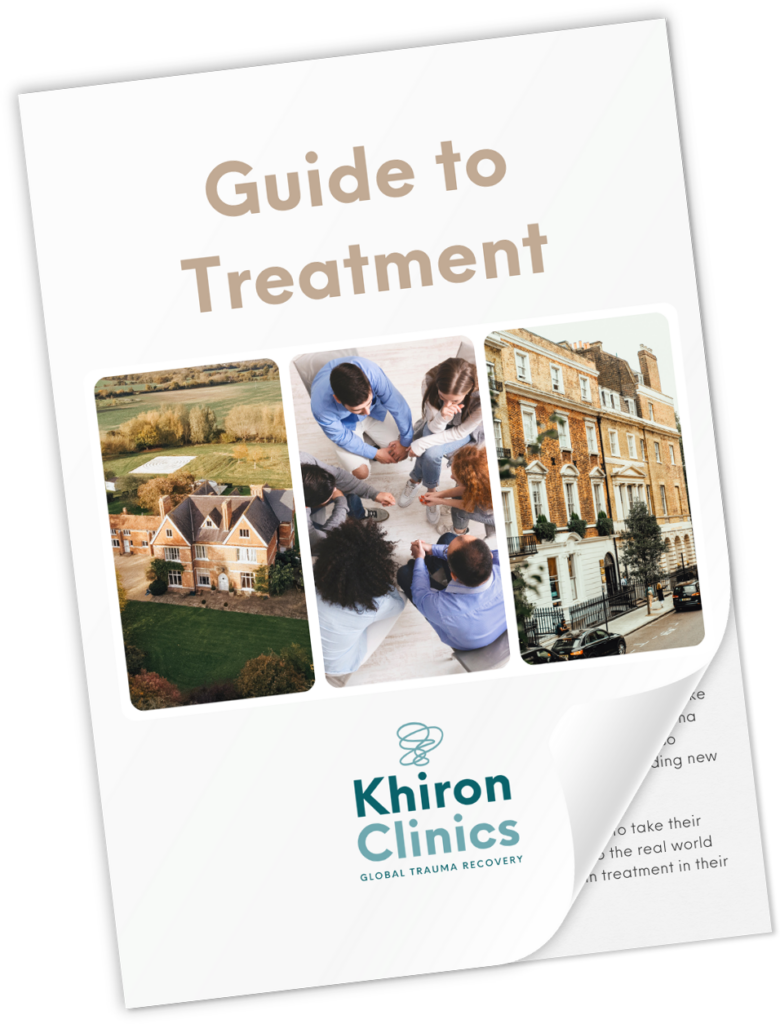
guide-to-treatment

Download the Brochure

Discover Our Innovative Trauma Recovery Pathway

Find out more about how we treat, what we treat, our clinics, pricing and more.

Next Steps

We Are Here to Help You Find the Path to Effective, Long Lasting Recovery.

An icon depicting a telephone receiver with a coiled cord, drawn in a minimalist style with blue lines. The receiver is positioned diagonally in an upwards orientation, reminiscent of the welcoming touchpoints often found at trauma clinics like Khiron Clinics.

Talk to Us

Get in touch with us and share your story if you feel comfortable with someone who will listen. Our team are always here to help.

Illustration of a desk calendar with spiral binding at the top. The calendar shows a grid of days with three rows, each row containing seven days. The design is simplistic and outlined in teal, evoking a sense of order and calm often emphasized in mental health treatment settings.

Book an Initial Consultation

Meet with a senior member of our clinical team and get insights into the root causes of your issues, plus a written summary and treatment recommendation.

A hand-drawn illustration of a folded newsletter or brochure. The cover features a rectangular image with a wave pattern above three horizontal lines of text, suggesting a simplistic design. The outline is in teal.

Download Our Brochure

Discover our innovative trauma recovery pathway. Find out more about how we treat, what we treat, our clinics, pricing and more.

Khiron Mental Health Clinics Guide to treatment

Discover Our Innovative Trauma Recovery Pathway

Find out more about how we treat, what we treat, our clinics, pricing and more.

"*" indicates required fields

This field is for validation purposes and should be left unchanged.

Request A Call Back

Contact Us